post

Happy Buyers!! Congratulations Mark & Mary.

Congratulations to our clients Mark and Mary Minotti of Property Circle LLC on the purchase of their North Haven, CT project/flip house today.

Over the next few months, they will tastefully update this 1950’s ranch home into a 2019 Dream Home. Watch the renovation progress on this blog as their project unfolds.

This transformed home will be available for purchase just in time for our spring 2019 buying market. It’s ideally located close to the new Amazon Distribution Center and the North Haven Campus. Potential buyers who are interested in getting on the waitlist for this one should contact me.

Contact Rick Bassett


post

The impact of infrastructure spending on the Federal Gasoline Tax

Today (June 6th) marks the 85th anniversary of The Revenue Act of 1932.  The Tax Act was designed to close a significant federal deficit (general fund) gap of just over $1 billion at the time. A component of the 1932 Tax Act was a 1 cent/gallon temporary gas/fuel tax that was scheduled to expire in 1934, this tax is known as the Federal excise tax on gasoline. Initially this excise tax was intended strictly for deficit reduction and not dedicated to building or maintaining infrastructure (roads and bridges).

Like all taxes, the Federal excise tax on gasoline never expired but it expanded. Today the excise tax sits at 18.4 cents/gallon for gasoline and 24.4 cents/gallon for diesel where it has remained steady since 1997 (the Clinton Administration). From it’s origins in 1932 until 1997 the excise tax was split in various percentages between deficit reduction (general fund) and infrastructure (Highway Trust Fund) but in 1997 President Clinton redirected the entire excise tax (100% of it) to the Highway Trust Fund. The Highway Trust Fund takes in about $35 billion a year from the Federal excise tax, which many lawmakers argue is insufficient to the tune of about $15 billion annually for maintaining the Nation’s infrastructure. Many lawmakers, including the normally tax increase adverse GOP,  have been calling for increases on this Federal excise tax for many years arguing that it is a consumption tax that pays for the infrastructure which it’s consumers (travelers) are using. 

Trump’s Infrastructure Plan: Trump has proposed to spend $1 trillion over 10 years on critical infrastructure spending plan to rebuild the country’s roads, bridges, airports, electric grid and water systems. Washington insiders have pegged the realistic direct federal spending on infrastructure much lower than $1 trillion at a range of $200 – $300 billion dollars, which is still significant. This is no clear pathway for Congress on how they would find the lower number of $300 billion in new money to pay for this plan. With funding details for this plan currently  about as clear as mud, the one thing for certain is that consumers can expect to pay significantly more at the pump in terms of Federal excise tax.

If just $300 billion of new infrastructure spending is approved over 10 years, it would translate to the Federal excise tax on gasoline increasing by 15.77 cents/gallon to 34.17 cents/gallon assuming consumers had to foot the entire bill.

Some of the obvious benefits of the proposed increased in infrastructure spending include: fixing a crumbling infrastructure that is badly in need of repair, lower vehicle repair costs to drivers caused by poorly maintained roadways, a safer transportation system, more jobs and less pollution emissions given that the higher cost of driving will reduce the amount of driving that takes place.

The big downside of the increased infrastructure spending is the additional pain at the pump for consumers and truck drivers. As most drivers know, the Federal excise tax isn’t the only tax that they pay at the pump. Drivers also pay State & Local gas taxes that vary from 12.25 cent/gallon in Alaska to 58.20 cents/gallon in Pennsylvania (30.64 and 76.60 cents respectably with the Federal excise tax included). The table above illustrates the State gas tax rates per gallon ranked from highest to lowest.

An increase in the Federal excise tax of 15.77 cents to cover the $300 billion in new infrastructure spending would translate into a 20 – 50% tax increase at the pump. In real dollars the increased tax equates to an additional $165 per year / per car that consumes 20 gallons per week.

If for some reason the entire $1 trillion in infrastructure spending was approved and passed onto consumers at the pump, which is highly unlikely, then it would translate into an increase in the Federal excise tax of nearly 50 cents per gallon representing a  65 – 163% tax increase at the pump with out of pocket cost to consumers increasing in excess of $500 per year / per car that consumes 20 gallons per week.

The silver lining in this $1 trillion cloud is that the increased tax would probably put the U.S. into compliance with the Paris Climate Agreement by significantly reducing the number of cars on the road and thereby reducing our emissions.

So the question is do we root for higher Federal excise taxes given that the societal benefit seem to be substantial while on the other side of the ledger the penalties for low-wage earners would be potentially devastating?


Rick Bassett

post

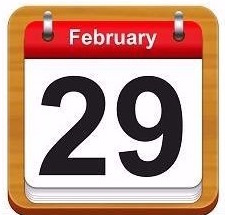
The origins of Leap Day

Feb29
Today is LEAP DAY!!

A YEAR is typically defined as 365 days, or roughly the length of time that it takes the Earth to orbit around the Sun once but in reality the Earth doesn’t complete it’s orbit around the sun in precisely 365 days, its actually closer to 365.2524 days (“a vernal equinox year”).

To make up for the ¼ of a day difference, a corrective measure or an extra day known as February 29, is usually added to the calendar every four years, and that day is called a leap day.

In 46 BC, Roman emperor Julius Caesar introduced the Julian calendar, which was an amended version of the Roman calendar, with an extra leap day (or intercalary day) every fourth year.

Gregorian calendarThe Julian calendar would’ve worked out perfectly except the Earth’s obit around the sun takes 365.2425 days and not precisely 365.25 days. So over a century, this small difference accumulated to a slightly more than three-quarters of a day. From the time the Julian calendar was introduced to the 16th Century AD, the beginning of spring shifted from March 23 to March 11.

In 1582 Pope Gregory XIII established the Gregorian calendar and introduced the century rule to correct the rounding error. If a leap year falls at the beginning of a century, a year ending in double zeroes, you only add a leap day if it’s divisible by 400. The century years 1600, 2000 and 2400 are leap years, but years 1700, 1800, and 1900 are not. The Gregorian calendar also shifted the beginning of spring to March 21.

post

There is far more to Dolly Parton than meets the eye

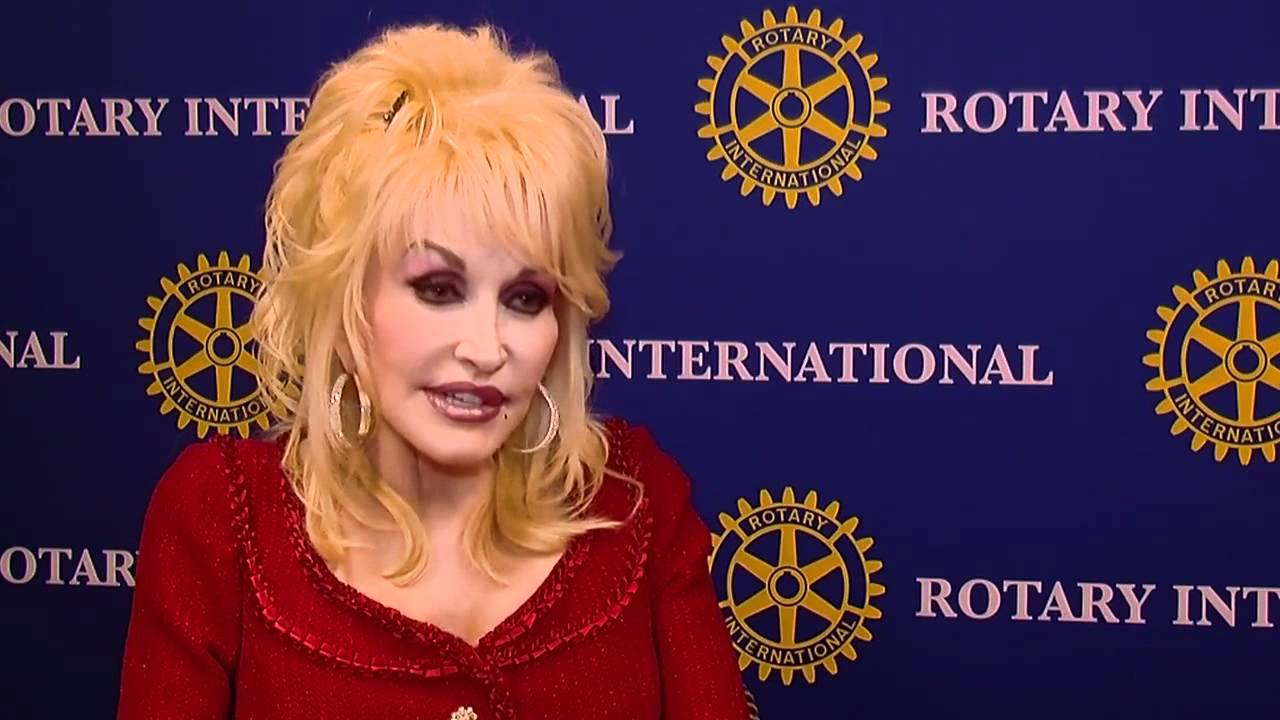
Dolly Parton is a Paul Harris Fellow and an Honorary Rotarian

Dolly Parton is a Paul Harris Fellow and an Honorary Rotarian in the Cleethorpes Rotary Club

Dolly Parton, born 70 years ago today, is mostly thought of as a widely successful  American singer-songwriter, which is true,  but there is far more to her than just that.

She’s also an actress, businesswoman, entrepreneur, philanthropist, dedicated Wife, Doctor of Letters, Paul Harris Fellow and a Rotarian.

Dolly came from very humble beginnings in Tennessee where she was 1 of 12 children who’s family was so poor that it’s rumored her father had to pay for her birth with a bag of grain.

She is perhaps one of the most decorated musical talents in history with 25 certified Gold, Platinum or Multi-Platinum Records, 26 songs reaching No. 1 on the Billboard country charts, 42 career top-10 country albums and over 100 million recordings recording sold world-wide.

But don’t think for a moment that Dolly is a one-dimensional Gal…..as she’s never forgot her roots in poverty or the early struggles that her family endured as a result of her father being unable to read and write.

Dolly is a hands-on philanthropist who leverages her talents, her resources and her entrepreneurial skills to improve the lives of many others. A brief highlight of a seemingly endless list of Dolly’s good deeds include:

  • Being a longtime supporter of charities, especially those relating to literacy.
  • She established the Imagination Library in 1995, which sends one book per month to children from the time of their birth until they enter kindergarten. Many Rotary Clubs partner in this program.
  • Giving $500,000 to Fort Sanders Medical Center to help launch a new Cancer Hospital
  • Leading significant efforts to preserve the bald eagle through the American Eagle Foundation’s sanctuary at Dollywood.
  • Giving out countless scholarships through her foundation.

She’s very aware of her public persona and isn’t above poking a little fun at herself.

When asked in a recent interview if she’s had work done, she replied “It takes a lot of money to look this cheap”.

John Germ & Dolly Parton

John Germ & Dolly Parton

Dolly received an honorary doctorate of humane and musical letters from the University of Tennessee in Knoxville in 2009, so she’s really Dr. Dolly – or Double D as she referred to herself to RIPE John Germ on the stage of the Rotary International Convention in Montreal in 2011. Dolly was a keynote speaker at that conference and closed it with a performance of 9 to 5.

At 70 years old Dolly is still an energetic beauty with an amazing voice that shows no signs of slowing down as she’s still a significant presence in the music industry, works actively on her foundation to make the world place and generously gives of her time and talents to her family.

Dolly epitomizes Service Above Self by giving of herself day in and day out, she is the ultimate model of what a Rotarian is all about.

Dolly is also Paul Harris fellow – presented by RIPE John Germ in Montreal and she’s a Rotarian – a member of the Cleethorpes (Grimsby, UK) Rotary Club.

I wish that the North Haven Rotary Club thought of inviting her first.

Rick B

post

New RI Theme Announced: ROTARY SERVING HUMANITY (38 Years of Rotary International Themes)

Each January, as Rotary District governors-elect from all over the world gather at the International Assembly for training and fellowship, the then Rotary International President-elect announces his (hopefully soon to be her) RI Theme.

The RI Theme sets the tone for what Rotary Clubs around the world will work towards once the Rotary International President-elect (RIPE), the 534 District governors-elect (DGEs) and the 35,000 Rotary Club Presidents-elect begin their new year on July 1st.

The excitement, anticipation and fanfare around RI Theme announcements have been a Rotary staple for the since 1955  and this year was no exception as RI President-elect John F. Germ said, and that being a part of Rotary is a “great opportunity” to make that happen.

Germ unveiled the 2016-17 presidential theme, Rotary Serving Humanity, to incoming district governors on 18 January at the International Assembly in San Diego, California, USA.

“I believe everyone recognizes the opportunity to serve Rotary for what it truly is: not a small opportunity, but a great one; an opportunity of a lifetime to change the world for the better, forever through Rotary’s service to humanity,” said Germ.

Rotary members around the globe are serving humanity by providing clean water to underdeveloped communities, promoting peace in conflict areas, and strengthening communities through basic education and literacy. But none more important than our work to eradicate polio worldwide, he said.

The timing of releasing RI Themes is carefully choreographed to the training which incoming District Governors (known as District Governors-elect) and Club Presidents (known as Presidents-elect) receive as the added significance of the RI Theme is to keep Rotary fresh each year while provide unique inspiration to the incoming world-wide leadership.

Below are the RI Theme Pins for the past 37 years. Merchandising the RI Theme on pins, ties, scarfs, clothing, banners and other giftware has evolved steadily since 1979-80. Prior to that the RI Theme was communicated in booklet form.


post

Nellie Tayloe Ross – The First U.S. Female Governor

Nellie Tayloe Ross

Nellie Tayloe Ross (American Heritage Center)

On this date (Jan 5th) in 1925 Nellie Tayloe Ross became the first female governor in the United States when she was sworn in as the 14th governor of Wyoming. She handily won a special election to finish out the remaining term of her predecessor, who happened to be her husband, who passed away from complications with an appendectomy just 1.5 years into his elected term.

Her platform of tax cuts, government assistance for poor farmers, banking reform, and laws protecting children, women workers, and miners and the strengthening of prohibition laws were in lockstep with her late husbands.

Women had only had the vote nationwide for just over 4 years when Ross became governor.

Her strong support of the prohibition laws likely led to defeat in her bid for reelection in 1926. She served as governor from 1925 – 1927.

In 1928 she was a strong supporter and campaigner for Al Smith‘s presidential bid. Despite their diametrically opposed views on prohibition, Ross received 31 votes from ten states for vice president on the first ballot at the 1928 Democratic National Convention. She is believed to have been the first female given serious consideration for the position of Vice President of the United States, although Joseph Smith from Arkansas ultimately received the nomination.

When Smith lost to Herbert Hoover, Ross was offered the  job of director of the Women’s Division of the National Democratic Committee, which she accepted and moved to Washington D.C..

Nellie Tayloe Ross on her Mint medal designed by Chief Engraver John R. Sinnock

Nellie Tayloe Ross on her Mint medal designed by Chief Engraver John R. Sinnock

Ross was appointed director of the U.S. Mint by President Franklin D. Roosevelt in 1933 making her one of the first women to hold a federal post of that importance. During her 20-year term the mint introduced the Roosevelt dime, the Jefferson nickel, and the steel penny, the latter an emergency measure during World War II.

Roosevelt appointed her to (3) five-year terms in the job, and President Harry Truman appointed her to a fourth term, a role which she served in until her retirement 1953.

After  retirement,  she made a number of profitable real estate investments, contributed to a number of magazines, traveled extensively and spent time with her children and grandchildren.

Governor Nellie Tayloe Ross lived to the age of 101 (11/29/1876 – 12/19/1977), she passed away in Washington D.C.

Footnote: Ross had the distinction of becoming the first woman governor by a small margin; Miriam Ferguson was inaugurated governor of Texas just 16 days later.